
Table
Hello, I’m Dr. Hyo wan Suh, a board-certified plastic surgeon and Medical Director of Lively Plastic Surgery : Revitalizing Your Natural Beauty.
“My eyelids feel so heavy when I open my eyes, and people keep telling me I look sleepy.”
This is something I hear constantly in consultations. A perpetually tired or sleepy appearance, eye fatigue, a sense that your field of vision is restricted — these are common complaints among patients with blepharoptosis (ptosis).
If any of the following apply to you, I’d encourage you to read this article through to the end:
✅ People often tell you that you “look tired” or “look sleepy”
✅ You unconsciously tilt your chin up to see clearly
✅ You feel tension in your eyebrows and forehead when opening your eyes
✅ Your eyelids feel like they’re drooping enough to partially block your vision
If you checked any of these boxes, ptosis may be worth investigating.
Today, I’ll walk you through the causes and symptoms of ptosis in detail, along with the national health insurance coverage criteria that many patients ask about. (this part, unfortunately, only applies to those covered under Korea’s national health insurance).
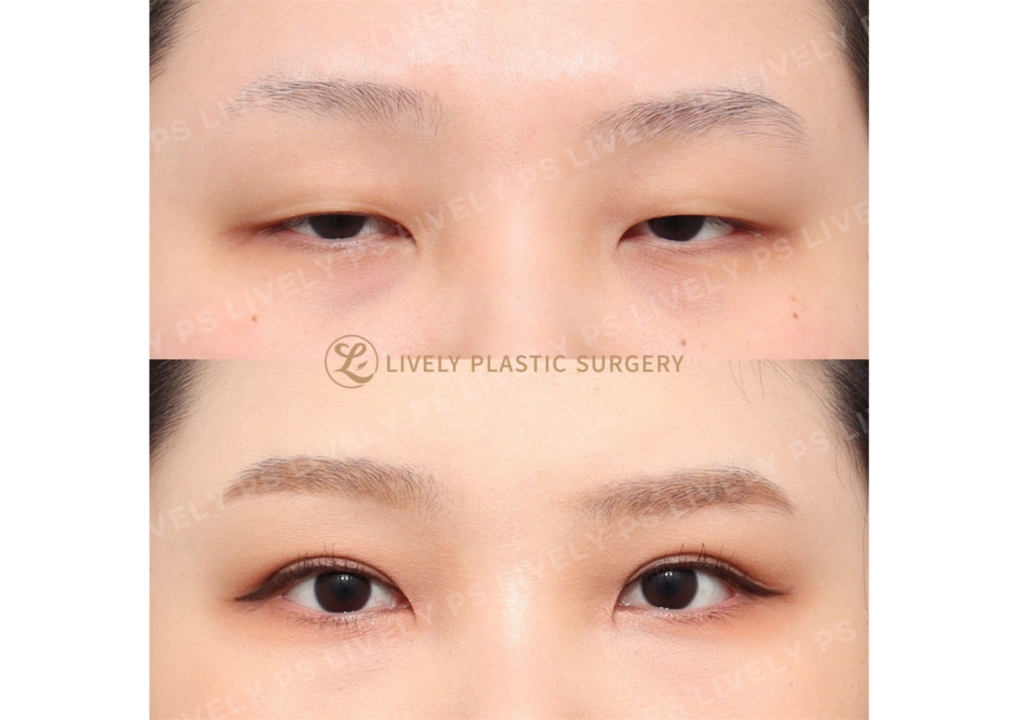
[Ptosis correction, pre / postoperation 2 month ]
Results vary by individual for all surgical procedures and treatments, and side effects or complications carry risk.
Ptosis: True vs. Pseudo, Depending on the Cause
Even when eyelids appear similarly droopy on the surface, the underlying cause of ptosis determines a completely different treatment approach.
Broadly speaking, ptosis falls into two categories: true ptosis and pseudoptosis.
| Category | Cause | Characteristics |
|---|---|---|
| True ptosis | Weakened function of the levator muscle (the muscle that lifts the eyelid) | Even when trying to open the eyes normally, reduced muscle movement prevents the eyelid from lifting properly |
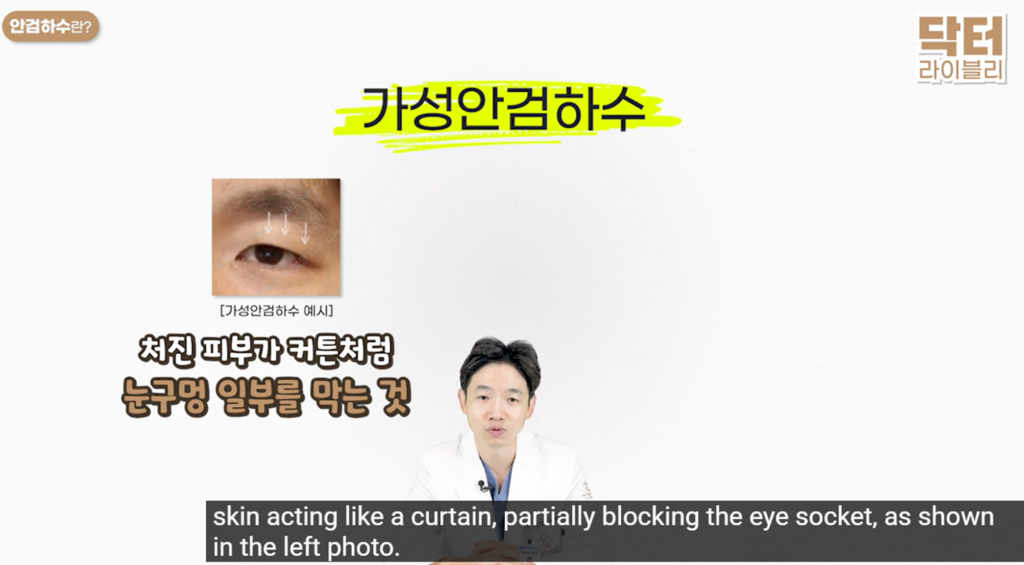
| Pseudoptosis | Loose eyelid skin draping over the eye like a curtain | The muscle itself functions normally; sagging skin is the core issue |
Because true ptosis stems from weakened muscle strength, it requires a correction procedure that reinforces levator muscle function in proportion to the degree of drooping.
Pseudoptosis, on the other hand, is a skin issue — upper eyelid surgery to remove excess skin, or a sub-brow lift, can often provide sufficient improvement.
In actual clinical practice, however, these two conditions frequently occur together, which often calls for a surgical plan that addresses both muscle and skin simultaneously.
The key is not to judge by appearance alone. If a patient with weak muscle function undergoes only double-eyelid surgery, or only has excess skin removed, the eyelid can actually end up feeling heavier than before surgery — so caution is essential.
Before surgery, it’s important to choose a clinic that can accurately assess factors like the function of the eyelid-lifting muscle, brow ptosis(different from blepharoptosis), and the degree of eye protrusion — and then design and carry out the surgery best tailored to those findings.
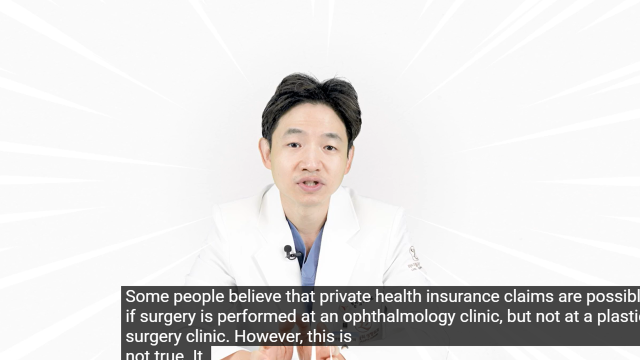
If It’s True Ptosis, How Does Correction Proceed?
Once true ptosis is diagnosed, ptosis correction surgery is needed — and the surgical method depends on how much muscle function remains.
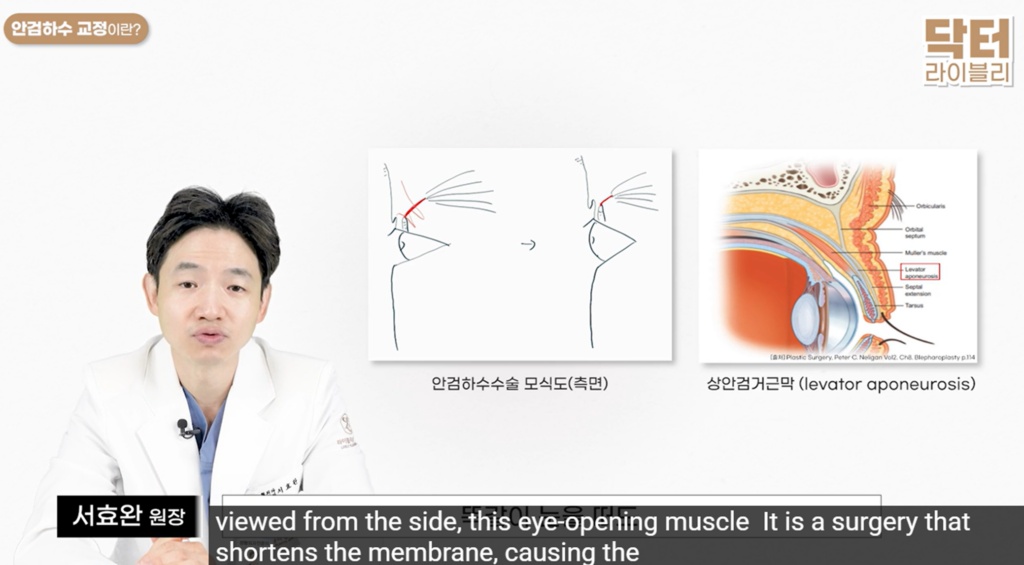
• When some muscle function remains: Levator resection/shortening surgery is typically used. Similar to how tying off a stretched rubber band shortens it and restores tension, this procedure cuts or pulls the weakened muscle and fixes it to the tarsal plate to strengthen its lifting power. Because it preserves as much of the original muscle movement as possible, patients can generally expect a natural, physiologically sound improvement without significant issues opening or closing the eyes.
• When almost no muscle function remains: Standard levator resection/shortening surgery cannot achieve good results in this case.
Procedures such as frontalis sling surgery or Conjoint Fascial Sheath (CFS) surgery are needed, which transfer lifting power from other tissue to the eyelid to help it open.
Which method is appropriate can only be determined after precisely measuring the individual’s muscle condition.
For this reason, I’d encourage patients to seek out a plastic surgeon experienced not only in simple cosmetic procedures but also in severe ptosis cases, to achieve the best results tailored to their specific condition.
What Are the National Health Insurance Coverage Criteria for Ptosis Surgery? (for Korean)
Ptosis can be classified into the following stages by severity:
(Normal eye: in neutral gaze — looking straight ahead without using the forehead muscles — less than 1–2mm of the superior corneal margin, is covered.)
- Mild: Upper eyelid covers 2mm or less of the superior corneal margin
- Moderate: Covers approximately 2–4mm
- Severe: Covers 4mm or more
Many patients assume that any case of ptosis qualifies for insurance coverage, but the criteria set by Korea’s Health Insurance Review & Assessment Service (HIRA) are quite specific and strict.
The core question is: does an actual functional impairment exist, beyond purely aesthetic concerns?
✅ Key Insurance Coverage Criteria (Notification No. 2009-96)
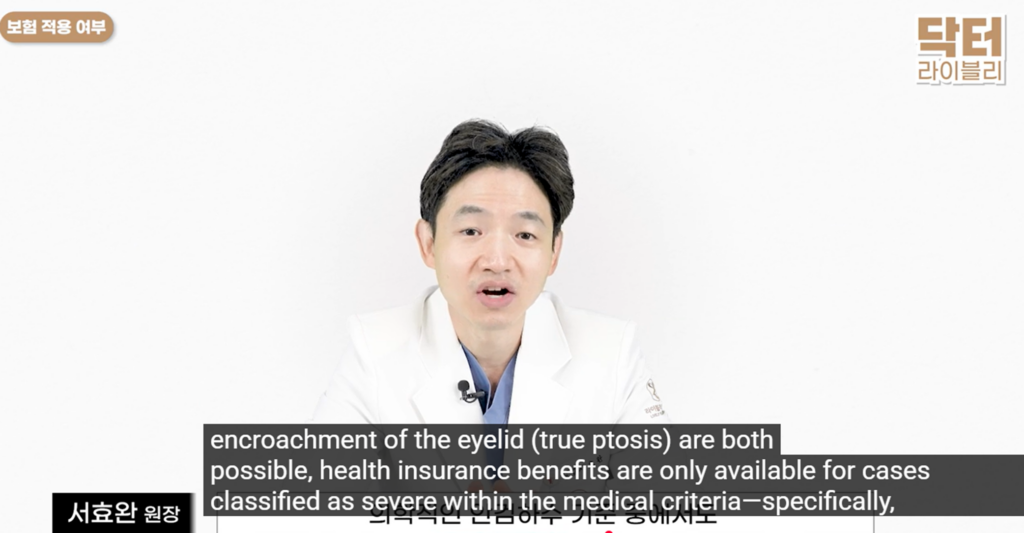
Coverage applies when, during forward gaze, the eyelid skin or eyelid margin encroaches on the pupil (the center of the eye) and restricts the field of vision.
- Objective visual impairment: It’s not enough for the eyes to simply look smaller — the drooping eyelid must obstruct vision to a degree that interferes with daily life.
- Objective measurement: Insurance coverage is limited to medically severe ptosis, where the upper eyelid covers 4mm or more of the superior corneal margin.
- Diagnosis: A detailed examination by a board-certified plastic surgeon must measure levator muscle function and the degree of visual field restriction, supported by documented evidence.
In other words, not all ptosis surgeries qualify for insurance — coverage is explicitly limited to “severe” cases.
FAQs About Ptosis
Q. If I get ptosis surgery, will it automatically be covered by insurance?
A. No. Coverage requires severe ptosis (where, in neutral gaze, the upper eyelid clearly covers the pupil) with objectively confirmed functional visual impairment, verified through a detailed examination by a board-certified plastic surgeon.
Q. How is true ptosis distinguished from pseudoptosis?
A. The two are often difficult to distinguish visually, so a precise diagnosis by a board-certified plastic surgeon is needed to assess both levator muscle function and the degree of skin sagging together.
Q. If my eyebrows are drooping, is it okay to get ptosis surgery?
A. If brow ptosis is present, a brow lift (forehead lift) may be more appropriate. When it occurs alongside ptosis, both procedures are sometimes performed together.
An Accurate Diagnosis Comes First
Realistically, even moderate ptosis can cause a range of daily inconveniences, which is why HIRA’s criteria can feel quite strict.
That said, without such strict standards, there’s a real risk of unnecessary surgeries being performed indiscriminately — so in some ways, this rigor serves an important purpose.
What matters most is getting a clear diagnosis of your current condition from a board-certified plastic surgeon.
If you’d like guidance, please feel free to reach out to us at Lively Plastic Surgery Clinic.
Thank you.