
Table
Hello, I’m Dr. Hyo wan Suh, a board-certified plastic surgeon and Medical Director of Lively Plastic Surgery : Revitalizing Your Natural Beauty.
“I understand the sub-brow lift gives great results… but won’t a scar right under the eyebrow show through, even with makeup?”
This is one of the questions I hear most often in consultations. A sub-brow lift is worth considering for patients with moderate to severe eyelid drooping who don’t want a double eyelid crease, or who prefer a natural correction without a dramatic change in appearance.
Most people who come in for this procedure want younger, brighter-looking eyes without an obvious “done” look — but understandably, many hesitate because of where the incision sits and whether the scar will be visible.
If you’ve read reviews mentioning a visible scar after a sub-brow lift, it’s natural to wonder whether the procedure is right for you. Today I’ll explain why sub-brow lift scars heal so differently from person to person, and what actually determines how noticeable a scar ends up being.
Every incision-based procedure leaves some kind of scar. However, the degree of scarring from sub-brow lift surgery can vary significantly depending on the incision location and surgical technique.
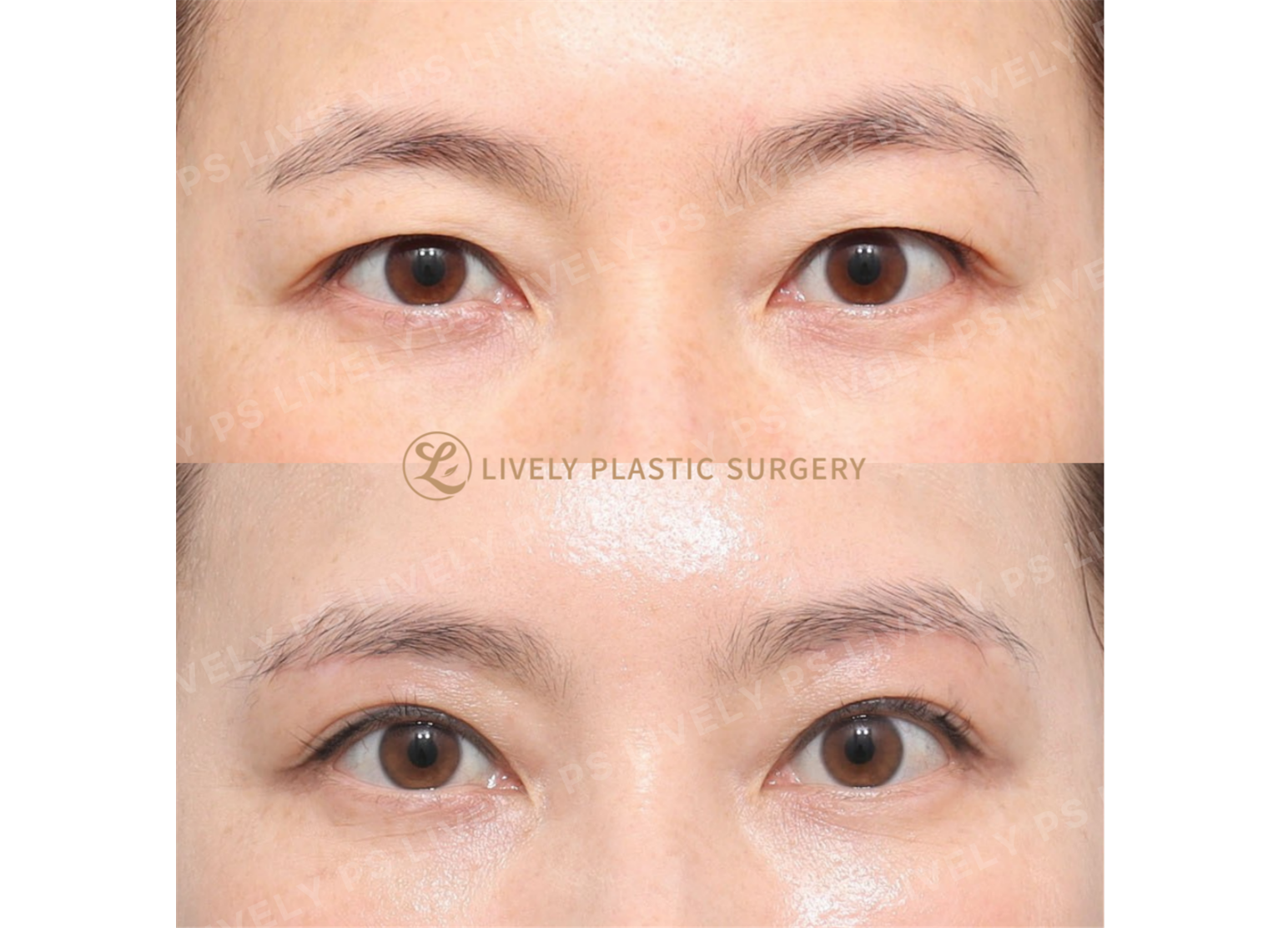
[Sub-brow Lift, pre / postoperation 1 month ]
Factor 1: Incision Placement
The most basic way to keep a scar from standing out is placing the incision exactly where it will be least visible.
Eyebrow hair naturally thins out toward the lower edge before transitioning into eyelid skin. Placing the incision along the upper portion of this transition zone helps it blend in far more effectively.
Some patients worry: “My eyebrows are already sparse — won’t the scar show no matter where the incision is placed?” This concern comes up often, especially among patients in their 50s and older, since eyebrow density naturally declines with age.
In these cases, the incision line may appear slightly redder immediately after surgery compared to patients with fuller brows. Even so, the scar typically starts to fade naturally around the 2–3 month mark as it matures, and by roughly 6 months most patients see it settle into a much less noticeable state.
For patients with extremely sparse eyebrows, one option — once the scar has matured for 2–3 months — is eyebrow tattooing to help camouflage the area naturally. In other words, thin eyebrows alone shouldn’t rule out this procedure.

Factor 2: Tension at the Incision Site
Even more important than placement is tension at the incision site.
The main reason a scar can widen, indent, or turn red and raised after surgery is that the skin is left bearing ongoing tension as it tries to pull apart.
At Lively Plastic Surgery Clinic, we always perform a deep-layer lift specifically to minimize scarring.
If only the surface skin is pulled and stitched when lifting a drooping eyelid, the skin closes under significant tension — and that tension makes the incision more prone to widening or scarring.
Our approach involves carefully dissecting the orbicularis oculi muscle beneath the skin and anchoring it to the frontalis muscle above for the lift.
When the underlying muscle layer supports the lifting effect, the skin on the surface can be closed gently, without bearing the force that would otherwise pull it apart.
Skin closed without tension tends to heal more stably. As a result, most patients find that by around 6 months, the scar is difficult to notice even up close.
After surgery, we also provide scar management tailored to each patient’s healing process— including recovery care and scar ointments — so this is generally not something to worry about excessively.

Who Is a Good Candidate — and What to Expect
| Good Candidates | What the Procedure Addresses |
|---|---|
| Moderate to severe eyelid drooping without significant brow ptosis | Correction of drooping eyelids |
| Those who want to improve sagging eyelids without a major change in overall appearance | Preserves existing double-eyelid line, minimal change to overall look |
A sub-brow lift corrects drooping eyelids while keeping the change to your overall appearance minimal — making it well suited for patients who don’t want a sudden new double-eyelid crease or a noticeably ‘done’ look.
One condition worth paying close attention to is “without significant brow ptosis.” Brow ptosis refers to eyebrows that have drooped for various reasons — either the distance between the eyebrow and eyelid has visibly narrowed (overt brow ptosis), or the forehead is habitually raised to open the eyes, leading to pronounced forehead wrinkles (hidden brow ptosis).
Operating without properly evaluating this beforehand can lead to an unintended sharp, intense appearance or worsened wrinkles — so this needs careful attention.
For this reason, a thorough pre-surgery consultation with an experienced board-certified plastic surgeon who can accurately assess these factors is essential.

Frequently Asked Questions
Q. How is a sub-brow lift different from upper blepharoplasty (double eyelid surgery)?
A. Upper blepharoplasty creates a double-eyelid crease while also correcting droopy eyelids. A sub-brow lift, on the other hand, works through an incision along the lower brow border and addresses eyelid drooping alone, without creating a crease.
Upper blepharoplasty tends to be more suitable for significant ptosis or noticeable eye asymmetry, while a sub-brow lift is often better suited for correcting sagging at the outer corner of the eye. Which approach fits best depends on the degree of eyelid drooping, whether brow ptosis is present, and individual goals — so an accurate diagnosis through consultation is essential.
Q. Can a sub-brow lift scar be completely removed?
A. Since this is an incision-based procedure, completely eliminating the scar isn’t realistic. That said, with proper incision placement and tension management, the scar often fades to a barely noticeable level, and additional scar care can be added if needed.
Q. How long does recovery take after a sub-brow lift?
A. Recovery varies by individual, but swelling and bruising generally subside gradually over about 2 weeks, while full scar maturation typically takes several months. The exact timeline depends on each patient’s eyelid condition and individual healing capacity.

Closing Thoughts
At Lively Plastic Surgery Clinic, our focus is on eye surgery and lifting procedures that look natural and stand the test of time.
I personally handle every consultation and diagnosis as Director, and rather than applying a one-size-fits-all approach, I plan each surgery around the individual patient’s eyelid condition, presence of brow ptosis, and other anatomical factors.
If you’re wondering whether a sub-brow lift, upper blepharoplasty, or forehead lift is the right fit for you, feel free to reach out to Lively Plastic Surgery Clinic for a consultation.
Thank you.